
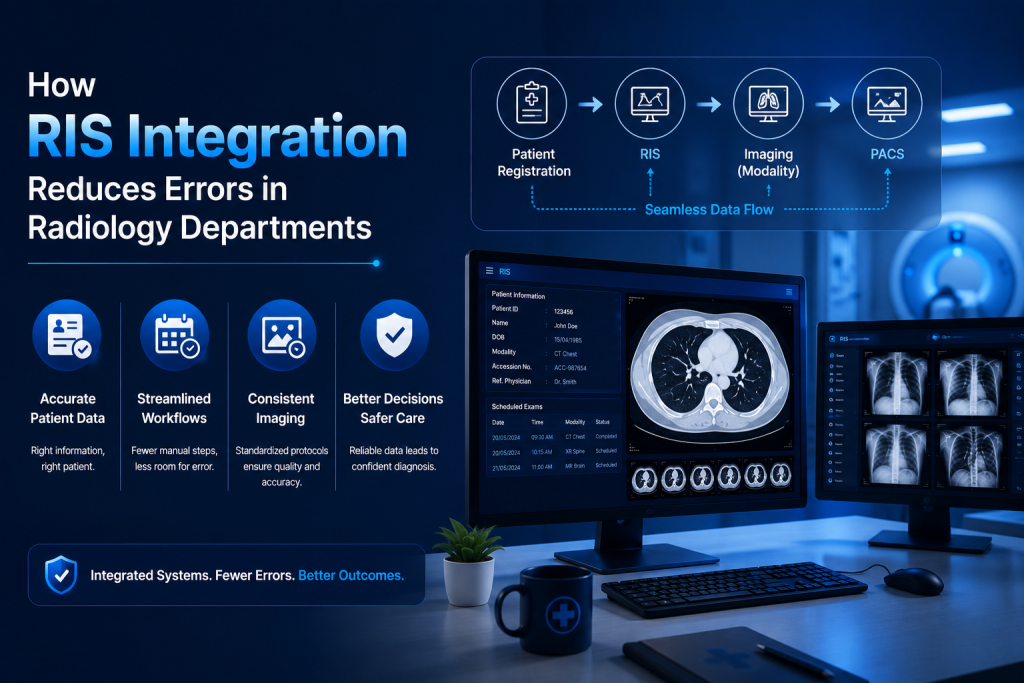
Radiology departments handle a large amount of patient information every day. From scheduling imaging exams to managing reports and sharing diagnostic results, every step in the workflow requires accuracy and coordination. Even small mistakes in patient data, imaging orders, or reporting can lead to delays, repeated scans, incorrect diagnoses, or treatment complications.
As imaging volumes continue to grow, hospitals are increasingly looking for ways to improve workflow efficiency while reducing human errors. One of the most effective solutions is RIS integration.
RIS, or Radiology Information System, helps manage radiology operations such as patient registration, scheduling, reporting, billing, and workflow tracking. When RIS is properly integrated with PACS, hospital systems, and reporting platforms, radiology departments can operate more smoothly and with fewer mistakes.
This blog explains how RIS integration reduces errors in radiology departments and supports faster, more reliable patient care.
Understanding RIS Integration
A Radiology Information System is designed to organize and manage radiology workflows digitally. However, RIS becomes much more powerful when integrated with other healthcare systems such as:
- PACS (Picture Archiving and Communication System)
- HIS (Hospital Information System)
- EMR or EHR platforms
- Reporting software
- Scheduling systems
RIS integration allows information to move automatically between systems instead of requiring repeated manual entry. This connected workflow improves accuracy and efficiency across the radiology department.
Common Errors in Radiology Departments
Radiology workflows involve multiple steps and several healthcare professionals. Without proper integration, errors can occur easily.
Some common problems include:
- Incorrect patient information
- Duplicate records
- Wrong imaging orders
- Lost or delayed reports
- Mismatched imaging studies
- Communication gaps between departments
These issues not only slow workflows but can also affect diagnosis and patient safety.
Reducing Manual Data Entry Errors
One of the biggest advantages of RIS integration is reducing manual data entry.
In disconnected systems, staff often need to enter the same patient information multiple times across different platforms. This increases the risk of spelling mistakes, incorrect patient IDs, or duplicate records.
Integrated RIS systems automatically synchronize data between hospital systems and PACS. Patient demographics, appointment details, and imaging orders are shared instantly across platforms.
This helps radiology departments:
- Improve patient record accuracy
- Eliminate duplicate data entry
- Reduce administrative workload
- Prevent patient identification errors
Automated workflows greatly reduce the chances of human mistakes.
Improving Imaging Order Accuracy
Incorrect or incomplete imaging orders can create confusion and delay diagnosis. In some cases, patients may undergo the wrong examination or need repeat scans.
RIS integration helps prevent these problems by connecting directly with hospital systems and physician orders.
Benefits include:
- Automatic order transfer
- Standardized imaging requests
- Clear communication between departments
- Reduced risk of missing information
Radiology staff receive accurate exam details immediately, improving workflow efficiency and patient safety.
Preventing Study Mismatches
A serious issue in radiology is mismatching imaging studies with the wrong patient record. This can lead to reporting errors and incorrect treatment decisions.
Integrated RIS systems reduce this risk by ensuring that patient demographics and study information remain synchronized across all platforms.
When RIS and PACS work together properly:
- Images are linked to the correct patient automatically
- Worklists update in real time
- Study tracking becomes more reliable
This improves confidence in reporting accuracy and reduces workflow confusion.
Faster and More Accurate Reporting
Radiologists often work under pressure while reviewing large imaging volumes. Switching between disconnected systems for patient data, prior studies, and reporting tools can increase the risk of mistakes.
RIS integration streamlines reporting by providing centralized access to:
- Patient history
- Imaging studies
- Worklists
- Prior reports
Radiologists can complete reports more efficiently without unnecessary interruptions. Faster workflows also reduce reporting delays during busy periods.
Better Communication Between Departments
Radiology departments constantly communicate with physicians, technicians, emergency teams, and administrative staff. Without proper integration, communication gaps may occur, leading to delays or missing information.
RIS integration improves communication by allowing real-time updates across systems.
Healthcare teams can:
- Track patient progress
- Monitor exam status
- Access reports faster
- Coordinate care more efficiently
Improved communication helps reduce operational errors and supports smoother patient management.
Supporting Emergency Radiology Workflows
Emergency departments depend heavily on radiology for fast diagnosis. Delays or errors in imaging workflows can affect critical treatment decisions.
RIS integration supports emergency workflows by enabling:
- Faster patient registration
- Immediate imaging order processing
- Real-time worklist updates
- Quick report delivery
Radiologists can prioritize urgent studies more effectively, helping doctors begin treatment sooner.
Enhancing Workflow Tracking and Accountability
Modern RIS platforms provide detailed workflow tracking tools that help hospitals monitor radiology operations.
Integrated systems allow administrators to:
- Track imaging orders
- Monitor report turnaround times
- Identify workflow bottlenecks
- Review audit logs for user activity
This improves accountability and helps healthcare facilities maintain consistent workflow standards.
Better Compliance and Data Security
Patient information in radiology departments must remain secure and compliant with healthcare regulations. RIS integration supports secure workflows through:
- Controlled user access
- Encrypted data transfer
- Activity tracking
- Secure report sharing
Integrated systems reduce the risk of unauthorized access and help hospitals maintain regulatory compliance.
Supporting Future Radiology Technologies
Healthcare technology continues evolving with AI-assisted reporting, cloud PACS, and advanced workflow automation becoming more common. RIS integration creates a strong digital foundation for adopting these innovations.
Hospitals with integrated radiology systems can more easily implement:
- AI workflow tools
- Teleradiology services
- Cloud-based imaging systems
- Advanced analytics platforms
This future-ready infrastructure improves long-term operational efficiency.
Conclusion
Radiology departments rely on accuracy, speed, and smooth communication to deliver high-quality patient care. Manual processes and disconnected systems often increase the risk of workflow errors, reporting delays, and administrative inefficiencies.
RIS integration helps reduce these problems by connecting radiology workflows into one coordinated system. By automating data synchronization, improving communication, reducing manual entry, and streamlining reporting processes, integrated RIS systems improve both operational efficiency and patient safety.
As imaging volumes continue to grow, hospitals need smarter radiology infrastructure that supports reliable and error-free workflows. RIS integration is becoming an essential part of modern radiology departments, helping healthcare providers deliver faster, more accurate, and more efficient diagnostic services.
FAQs
RIS integration connects the Radiology Information System with PACS, HIS, EMR, and reporting platforms. It enables automatic data sharing between systems, reducing manual tasks and improving workflow efficiency across the radiology department.
RIS integration minimizes manual data entry by automatically synchronizing patient information, imaging orders, and reports. This reduces the risk of duplicate records, incorrect patient details, and study mismatches that can impact diagnosis and treatment.
Yes, integrated RIS systems provide radiologists with quick access to patient history, imaging studies, and prior reports in one place. This helps reduce workflow interruptions, supports accurate reporting, and improves overall diagnostic confidence.
In emergency settings, RIS integration speeds up patient registration, exam scheduling, image tracking, and report delivery. Real-time updates help radiologists prioritize urgent cases, allowing clinicians to make faster treatment decisions.
Modern RIS integration includes features such as secure data transfer, role-based access controls, audit logs, and workflow tracking. These measures help protect patient information, improve accountability, and support healthcare compliance requirements.