
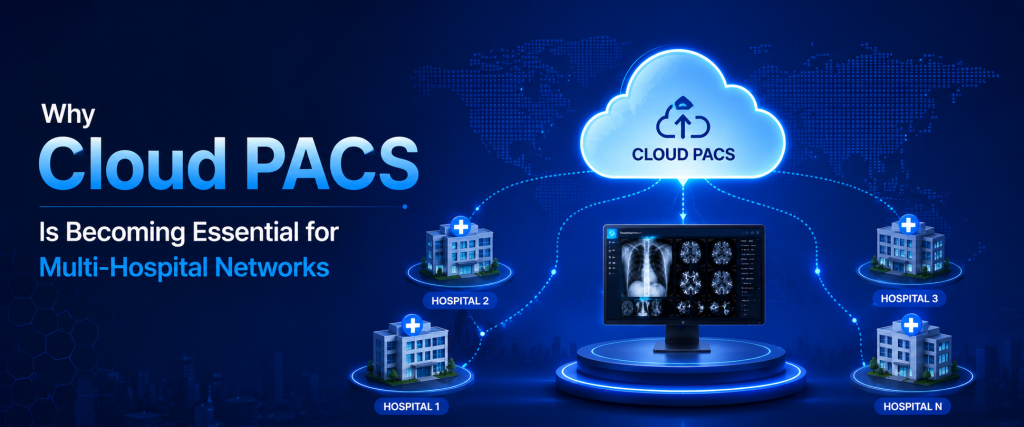
Healthcare systems are expanding rapidly, and many hospitals now operate across multiple branches, cities, or healthcare networks. While this growth improves patient access to medical services, it also creates new challenges for radiology departments. Managing imaging data across different locations can become complicated when hospitals rely on outdated or disconnected systems.
Modern healthcare requires fast image access, smooth collaboration, remote reporting, and centralized workflow management. Traditional PACS systems often struggle to support these demands in multi-hospital environments because they depend heavily on local infrastructure and physical servers.
This is why many healthcare organizations are moving toward Cloud PACS solutions. Cloud technology allows hospitals to connect imaging operations across multiple locations through a secure and centralized platform. It improves workflow efficiency, reduces operational complexity, and supports faster patient care.
This blog explains why Cloud PACS is becoming essential for multi-hospital networks and how it helps modern healthcare systems manage radiology services more effectively.
The Challenges Faced by Multi-Hospital Networks
Managing radiology operations across multiple hospitals is much more complex than running a single imaging center. Healthcare providers often deal with:
- Large imaging volumes from different locations
- Separate storage systems for each hospital
- Delayed image sharing between facilities
- Difficulty accessing patient history across branches
- Uneven radiologist workloads
- High infrastructure and maintenance costs
These problems can slow diagnosis, create workflow inefficiencies, and increase operational expenses.
What Is Cloud PACS?
Cloud PACS stands for Picture Archiving and Communication System hosted on secure cloud infrastructure instead of local hospital servers.
It allows hospitals to:
- Store medical images centrally
- Access studies remotely
- Share imaging data instantly
- Support teleradiology workflows
- Integrate multiple hospitals into one system
Cloud PACS supports imaging modalities such as CT scans, MRI, ultrasound, X-rays, mammography, and PET studies through a connected digital platform.
Centralized Imaging Access Across All Hospitals
One of the biggest benefits of Cloud PACS is centralized image management.
In traditional setups, each hospital may maintain separate imaging servers and local storage systems. Accessing studies from another branch can take time and may require manual transfers.
Cloud PACS creates a unified imaging environment where authorized users can access studies from any connected hospital location.
This helps healthcare providers:
- Retrieve patient studies faster
- View prior imaging history easily
- Reduce duplicate imaging exams
- Improve continuity of care
Centralized access simplifies radiology workflows across the entire network.
Faster Collaboration Between Hospitals
Modern patient care often requires collaboration between specialists working in different hospitals. Traditional systems can slow communication because image sharing may depend on physical transfers or complicated network setups.
Cloud PACS allows instant sharing of imaging studies across locations. Radiologists, physicians, and specialists can review the same case simultaneously from different hospitals.
This improves:
- Emergency consultations
- Specialist referrals
- Multi-disciplinary treatment planning
- Second opinion workflows
Faster collaboration supports quicker diagnosis and treatment decisions.
Better Support for Teleradiology Services
Multi-hospital networks often depend on teleradiology to manage workloads efficiently. Some hospitals may lack specialist radiologists for certain cases, especially during nights or emergencies.
Cloud PACS makes remote reporting easier by allowing radiologists to securely access imaging studies from anywhere.
Benefits include:
- 24/7 reporting coverage
- Faster emergency diagnosis
- Access to sub-specialty expertise
- Balanced workload distribution across hospitals
Radiologists can support multiple facilities without being physically present at each location.
Improved Workflow Efficiency
Disconnected imaging systems create workflow delays and administrative burden. Staff may spend extra time transferring studies, managing duplicate records, or coordinating between departments manually.
Cloud PACS streamlines workflow management by providing:
- Centralized worklists
- Integrated patient information access
- Faster image retrieval
- Unified reporting systems
Radiologists can review and report cases more efficiently because everything is available through one connected platform.
Lower Infrastructure and Maintenance Costs
Traditional PACS systems require significant investment in:
- Local servers
- Storage hardware
- Backup systems
- IT maintenance teams
- Physical infrastructure upgrades
For multi-hospital networks, maintaining separate infrastructure at every location can become extremely expensive.
Cloud PACS reduces these costs by shifting storage and system management to the cloud provider. Hospitals no longer need to maintain large local server environments across multiple branches.
This helps healthcare organizations:
- Reduce capital expenditure
- Lower maintenance costs
- Simplify IT operations
- Scale more efficiently
Cloud systems also provide predictable operational expenses through subscription-based models.
Scalability for Expanding Healthcare Networks
As healthcare organizations grow, imaging volumes and storage demands increase rapidly. Traditional systems often require expensive hardware upgrades when hospitals expand or add new locations.
Cloud PACS offers flexible scalability. Hospitals can:
- Add new facilities easily
- Expand storage without buying hardware
- Increase users and reporting capacity
- Support future growth efficiently
This makes cloud technology ideal for expanding healthcare networks.
Enhanced Data Security and Backup Protection
Medical imaging data contains highly sensitive patient information. Multi-hospital networks must ensure secure storage and controlled access across all locations.
Cloud PACS providers typically offer advanced security features such as:
- Encrypted image transmission
- Secure cloud storage
- Role-based access control
- Automatic backups
- Disaster recovery systems
Unlike local infrastructure, cloud systems reduce the risk of permanent data loss caused by hardware failures or natural disasters.
Supporting the Future of Digital Healthcare
Healthcare technology continues to evolve with artificial intelligence, telemedicine, and workflow automation becoming more common. Cloud PACS provides the flexibility needed to support these innovations.
Hospitals can integrate:
- AI-assisted diagnostics
- Advanced analytics
- Remote collaboration tools
- Future imaging technologies
Without rebuilding their entire infrastructure.
This future-ready approach helps healthcare organizations stay competitive while improving patient care.
Conclusion
Multi-hospital healthcare networks need imaging systems that are connected, scalable, and efficient. Traditional PACS infrastructure often creates workflow limitations, high maintenance costs, and challenges in collaboration between locations.
Cloud PACS is becoming essential because it allows hospitals to centralize imaging operations, improve remote access, support faster collaboration, and reduce infrastructure complexity. It helps radiologists and healthcare teams work more efficiently while improving patient care across multiple facilities.
As healthcare systems continue to expand, cloud-based imaging solutions are playing a major role in creating faster, smarter, and more connected radiology networks. Hospitals adopting Cloud PACS today are better prepared for the future of digital healthcare.
FAQs
Cloud PACS is a cloud-based Picture Archiving and Communication System that stores, manages, and shares medical images securely online. It allows healthcare professionals to access imaging studies from any authorized location, improving efficiency and collaboration across hospitals.
Cloud PACS centralizes imaging data from multiple hospitals into one platform, making it easier to access patient studies, share images, and coordinate care. This reduces delays, improves workflow consistency, and enhances communication between healthcare teams.
Cloud PACS enables radiologists to securely view and report imaging studies from any location with internet access. This supports teleradiology, after-hours reporting, and specialist consultations, ensuring faster diagnosis and continuous radiology coverage.
Yes, modern Cloud PACS solutions use advanced security measures such as encrypted data transmission, role-based access controls, automatic backups, and disaster recovery systems. These features help protect sensitive patient information and maintain compliance with healthcare regulations.
Absolutely. Cloud PACS is designed to scale easily as hospitals expand, add new locations, or increase imaging volumes. Organizations can grow storage capacity and user access without investing in expensive hardware upgrades, making it a future-ready solution.