
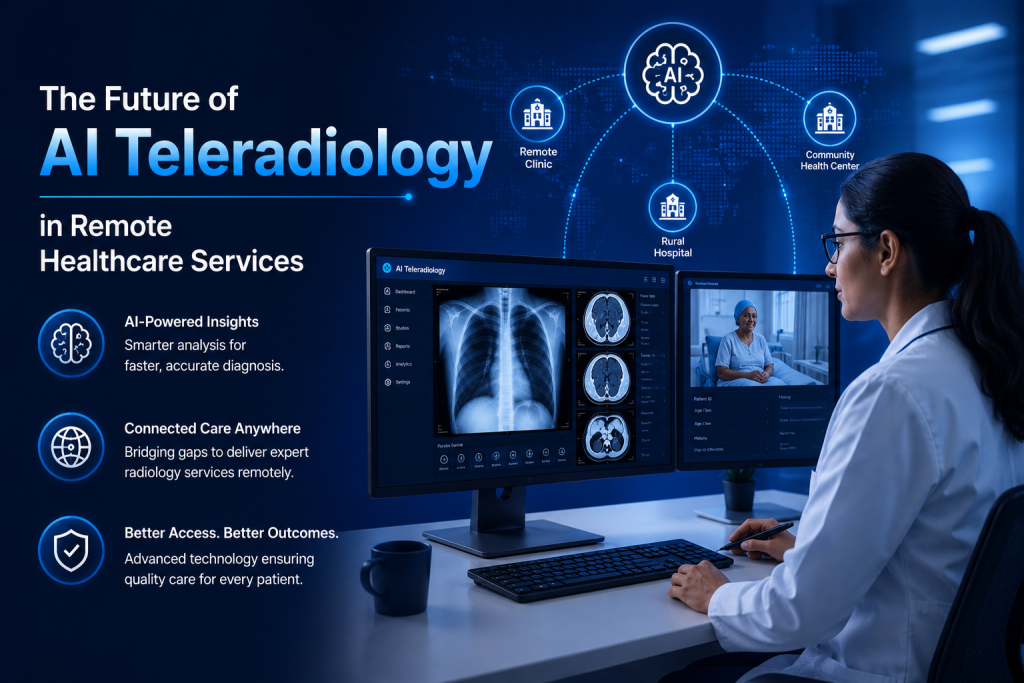
Healthcare is changing rapidly, and one of the biggest transformations is happening in radiology. Hospitals and diagnostic centers now generate massive amounts of imaging data every day through CT scans, MRI, X-rays, ultrasounds, and other advanced imaging technologies. At the same time, many regions still face a shortage of experienced radiologists, especially in rural and remote areas.
This growing gap between imaging demand and specialist availability has increased the importance of teleradiology. Today, radiologists can review and report scans remotely without being physically present in the hospital. However, as imaging volumes continue to rise, healthcare systems also need smarter tools that improve speed, accuracy, and workflow efficiency.
This is where AI teleradiology is shaping the future of remote healthcare services. By combining artificial intelligence with remote radiology workflows, healthcare providers can deliver faster diagnosis, better reporting support, and improved patient care across different locations.
This blog explains how AI teleradiology is transforming remote healthcare services and why it is becoming a critical part of modern radiology.
Understanding AI Teleradiology
Teleradiology allows medical images to be shared electronically so radiologists can review scans from remote locations. It helps hospitals provide radiology services 24/7, even when on-site specialists are unavailable.
AI teleradiology adds artificial intelligence tools to this process. AI teleradiology delivers even better performance when combined with a cloud based radiology PACS that enables secure remote access and faster image availability.
AI algorithms can analyze imaging studies, identify suspicious findings, prioritize urgent cases, and assist radiologists during interpretation.
The goal of AI is not to replace radiologists but to support them by improving workflow speed and reducing reporting pressure.
Why Remote Healthcare Needs Smarter Imaging Solutions
Many remote and rural healthcare facilities struggle with limited access to radiology specialists. Patients often face delays because scans must be transferred to larger hospitals for interpretation.
Common challenges include:
- Shortage of experienced radiologists
- Delayed emergency reporting
- High imaging volumes in urban hospitals
- Limited after-hours coverage
- Slow workflow management
AI teleradiology helps address these problems by improving efficiency and expanding access to expert imaging support.
Faster Detection of Critical Cases
One of the biggest advantages of AI in teleradiology is faster identification of urgent findings.
AI systems can quickly analyze imaging studies and flag abnormalities such as:
- Brain hemorrhage
- Stroke indicators
- Lung nodules
- Fractures
- Pulmonary embolism
- Internal bleeding
When urgent cases are prioritized automatically, radiologists can review critical studies first instead of manually sorting through large worklists.
This improves emergency response times and helps doctors begin treatment sooner.
Supporting Radiologists During High Workloads
Radiologists today often manage hundreds of studies daily. Fatigue and workload pressure can increase the risk of delays and missed findings.
AI teleradiology helps reduce workflow pressure by assisting with repetitive tasks such as:
- Case prioritization
- Preliminary abnormality detection
- Measurement calculations
- Workflow organization
This allows radiologists to focus more on clinical decision-making and detailed interpretation.
By improving efficiency, AI supports better reporting consistency even during busy periods.
Expanding Access to Specialist Care
Remote healthcare facilities may not always have access to sub-specialty radiologists such as neuroradiologists, cardiac imaging experts, or pediatric radiologists.
AI-supported teleradiology networks help connect smaller hospitals with experienced specialists located elsewhere. AI tools can also assist general radiologists by highlighting potential abnormalities before specialist review.
This improves diagnostic quality for patients in underserved regions and reduces the need for unnecessary patient transfers.
Improving Report Turnaround Time
Fast reporting is essential in healthcare, especially in emergency and critical care settings. Delayed imaging reports can affect treatment decisions and patient outcomes.
AI teleradiology improves turnaround times by:
- Prioritizing urgent studies automatically
- Streamlining radiology workflows
- Reducing manual administrative tasks
- Supporting faster image analysis
Radiologists can complete reports more efficiently while maintaining diagnostic accuracy.
Better Workflow Management Across Multiple Hospitals
Large healthcare networks often manage imaging studies from several hospitals and diagnostic centers. Coordinating workflows across different locations can become difficult without centralized systems.
AI teleradiology platforms help organize workloads more effectively by:
- Balancing case distribution
- Routing studies to available specialists
- Monitoring reporting timelines
- Managing high imaging volumes efficiently
This improves operational efficiency across multi-location healthcare systems.
Enhancing Accuracy Through AI Assistance
Artificial intelligence can analyze patterns in medical images that may be difficult to detect quickly during busy workflows.
AI tools assist radiologists by providing:
- Automated measurements
- Detection suggestions
- Quantitative analysis
- Comparison with prior studies
While final diagnosis always remains the responsibility of the radiologist, AI can serve as a valuable support system that improves confidence and consistency.
Cloud Technology and Remote Accessibility
The future of AI teleradiology depends heavily on cloud-based imaging systems. Cloud infrastructure allows radiologists and healthcare teams to access imaging studies securely from different locations.
Combined with AI, cloud teleradiology supports:
- Remote reporting from anywhere
- Faster collaboration between hospitals
- Secure image sharing
- Scalable radiology services
This flexibility is especially important for healthcare systems expanding across multiple locations.
Challenges and Considerations
Although AI teleradiology offers many benefits, healthcare providers must also consider important factors such as:
- Data privacy and cybersecurity
- AI validation and reliability
- Integration with existing hospital systems
- Training for radiologists and staff
- Regulatory compliance
Successful implementation depends on using AI as a support tool within well-managed radiology workflows.
The Future of Remote Healthcare Services
AI teleradiology is expected to become more advanced in the coming years. Future developments may include:
- Faster automated triage systems
- Improved AI-assisted diagnosis
- Predictive imaging analytics
- Smarter workflow automation
- Enhanced global collaboration between radiologists
As technology evolves, remote healthcare services will become more efficient, connected, and accessible.
Conclusion
Remote healthcare services are becoming increasingly important as healthcare providers work to deliver faster and more accessible patient care. Traditional radiology workflows alone may struggle to keep up with rising imaging demands and radiologist shortages.
AI teleradiology is helping transform remote healthcare by improving workflow efficiency, supporting faster diagnosis, prioritizing urgent cases, and expanding access to specialist expertise. Combined with cloud technology and modern imaging platforms, AI creates a more connected and future-ready radiology environment.
While artificial intelligence will not replace radiologists, it will continue to play a major role in supporting remote healthcare services and improving patient outcomes worldwide.
FAQs
AI teleradiology combines artificial intelligence with remote radiology services to help analyze medical images and prioritize urgent cases. It enables radiologists to access scans remotely while AI assists in detecting abnormalities and improving workflow efficiency for faster reporting.
AI teleradiology supports remote healthcare by providing quicker image analysis, faster report turnaround, and improved access to specialist radiologists. It helps hospitals and clinics deliver timely diagnoses, especially in rural or underserved areas with limited radiology expertise.
No, AI is designed to assist radiologists rather than replace them. It helps identify potential abnormalities, prioritize emergency cases, and automate repetitive tasks, while the final diagnosis and clinical decisions always remain the responsibility of qualified radiologists.
AI teleradiology improves reporting speed, enhances workflow efficiency, supports 24/7 remote reporting, reduces radiologist workload, and enables better collaboration between healthcare teams. These benefits help hospitals provide faster diagnoses and improve overall patient care.
As medical imaging volumes continue to increase, AI teleradiology offers scalable solutions that improve efficiency, support remote reporting, and integrate with cloud-based imaging systems. Its ability to assist radiologists while expanding access to quality diagnostic services makes it a key technology for the future of healthcare.