
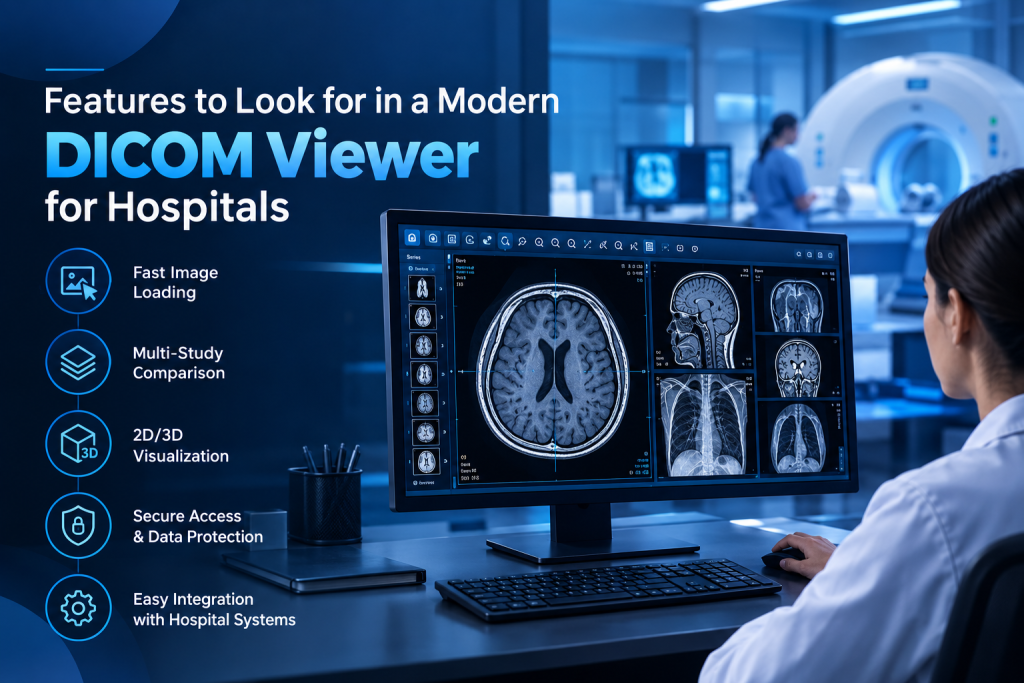
Medical imaging plays a critical role in modern healthcare, enabling doctors to diagnose conditions, monitor treatment progress, and guide surgical procedures. With the growing volume of imaging studies and the increasing complexity of cases, hospitals need advanced tools that allow radiologists to access, interpret, and share images efficiently.
A DICOM (Digital Imaging and Communications in Medicine) viewer is a vital tool for this purpose. DICOM viewers allow clinicians to view and manipulate images from multiple modalities, ensuring accurate diagnoses and streamlined workflows. Not all DICOM viewers are created equal, though. Choosing the right viewer can significantly impact efficiency, accuracy, and patient care.
1. Multi-Modality Support
Modern hospitals use various imaging modalities such as CT, MRI, X-ray, PET, and ultrasound. A robust DICOM viewer must support all these formats, allowing radiologists to:
- Access images from different devices in a single interface
- Compare studies across modalities for comprehensive diagnosis
- Avoid switching between multiple software platforms
Multi-modality support improves workflow efficiency and helps radiologists make better-informed decisions.
2. High-Resolution Image Display
Precision is critical in medical imaging. A high-quality DICOM viewer should offer:
- High-resolution display for clear visualization of fine details
- Zooming and panning tools to focus on areas of interest
- Windowing and leveling to enhance contrast and brightness
These features allow radiologists to detect subtle abnormalities that could be missed on lower-quality viewers, directly impacting diagnostic accuracy.
3. Multi-Planar Reconstruction (MPR)
Complex cases often require viewing anatomy in multiple planes—axial, coronal, and sagittal. A modern DICOM viewer should provide multi-planar reconstruction capabilities, which allow radiologists to:
- Analyze structures from multiple angles without additional scans
- Detect abnormalities that may not be visible in a single plane
- Save time and reduce the need for repeat imaging
MPR is particularly useful in neuroimaging, musculoskeletal studies, and oncology cases.
4. Annotation and Measurement Tools
Accurate reporting requires precise measurement and documentation. Look for a DICOM viewer with:
- Distance, area, and volume measurement tools
- Annotation options to highlight lesions, fractures, or other findings
- Ability to link measurements directly to reports
These tools streamline reporting and ensure that critical information is communicated clearly to referring physicians.
5. Integration with PACS and RIS
Modern hospitals rely on PACS (Picture Archiving and Communication System) and RIS (Radiology Information System) to manage imaging data and patient information. A DICOM viewer should integrate seamlessly with these systems to:
- Automatically retrieve patient studies
- Synchronize worklists and study orders
- Ensure that reports and images are linked accurately
Integration reduces manual work, minimizes errors, and enhances workflow efficiency.
6. Remote Access and Teleradiology Support
Teleradiology is increasingly important in today’s healthcare environment, enabling radiologists to review studies from remote locations. A modern DICOM viewer should allow:
- Secure remote access to imaging studies
- Viewing on multiple devices, including desktops, laptops, and tablets
- Collaboration with colleagues and specialists in real-time
This feature ensures timely reporting for urgent cases, improves access to expert opinions, and enhances patient care in remote or underserved areas.
7. AI and Advanced Analysis Integration
Artificial intelligence is transforming radiology by assisting in detecting abnormalities, prioritizing urgent cases, and automating measurements. A future-ready DICOM viewer should:
- Support AI-assisted tools for lesion detection and triage
- Provide quantitative analysis for treatment planning
- Integrate seamlessly with reporting workflows
AI integration reduces radiologist fatigue, improves accuracy, and accelerates reporting.
8. User-Friendly Interface
Ease of use is critical for busy radiologists. Look for a viewer with:
- Intuitive navigation and simple controls
- Customizable layouts and toolsets
- Quick access to frequently used features
A user-friendly interface reduces training time, minimizes errors, and allows radiologists to focus on image interpretation rather than software navigation.
9. Security and Compliance
Medical imaging data contains sensitive patient information. Modern DICOM viewers should include:
- Encrypted data transfer and secure storage
- Role-based access control to ensure only authorized personnel can view images
- Audit trails to track study access and modifications
Compliance with healthcare regulations like HIPAA ensures patient confidentiality while allowing efficient clinical use.
10. Performance and Scalability
Hospitals generate large volumes of imaging studies daily. A modern DICOM viewer should:
- Load large datasets quickly, including high-resolution CT and MRI scans
- Scale to handle increasing study volumes without performance issues
- Support multiple users simultaneously in multi-location facilities
Scalable performance ensures uninterrupted workflow, even during peak hours or high-volume periods.
Conclusion
A modern DICOM viewer is more than just an image viewer—it is a central tool for accurate diagnosis, efficient workflow, and effective collaboration in hospitals. By supporting multiple modalities, high-resolution imaging, MPR, annotations, PACS/RIS integration, remote access, AI tools, and secure data management, a DICOM viewer empowers radiologists to deliver faster and more accurate reports.
Choosing the right viewer can reduce errors, save time, enhance collaboration, and ultimately improve patient outcomes. Hospitals that invest in advanced, feature-rich DICOM viewers position themselves to meet the growing demands of modern radiology and provide high-quality, timely care to their patient
FAQs
A modern DICOM viewer is software that allows radiologists to view, analyze, and manage medical images from multiple modalities, enhancing accuracy and workflow.
Remote access enables secure viewing and reporting from anywhere, supports teleradiology, and ensures timely diagnoses for urgent or multi-location cases.
AI tools assist in detecting abnormalities, prioritizing critical cases, automating measurements, and improving reporting speed and accuracy.
By integrating with PACS/RIS, supporting high-performance imaging, providing annotation tools, and enabling collaboration, DICOM viewers streamline radiology operations efficiently.