
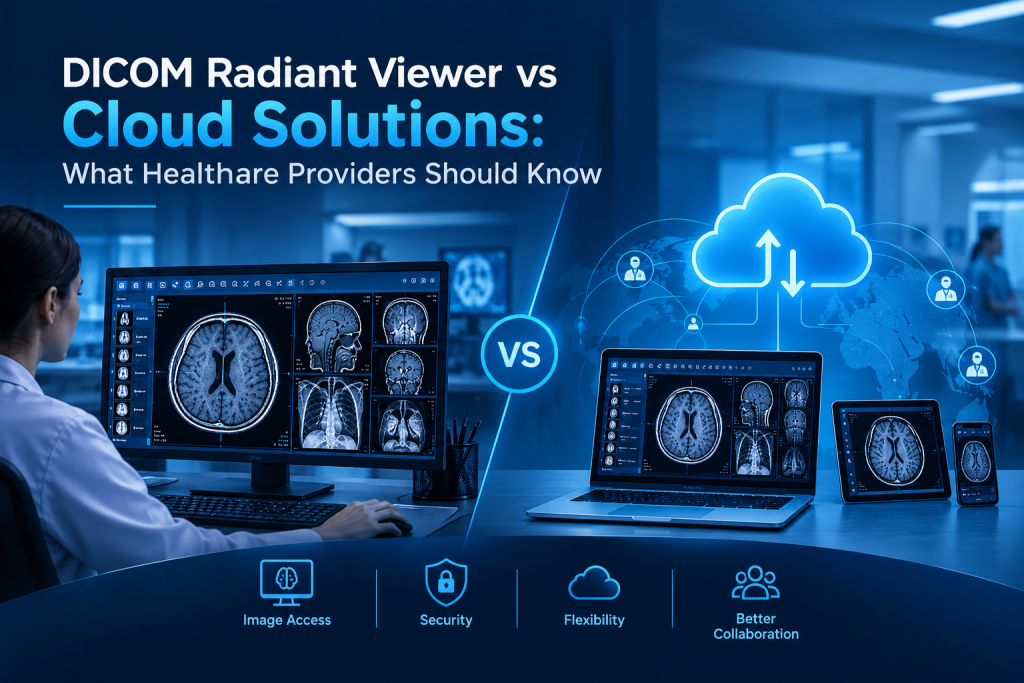
Medical imaging has undergone a significant transformation in recent years. Hospitals and diagnostic centers are handling increasing volumes of imaging studies, ranging from routine X-rays to advanced CT and MRI scans. To manage this data efficiently while maintaining diagnostic accuracy, healthcare providers rely on specialized tools like DICOM viewers and cloud-based imaging solutions.
Among DICOM viewers, the Radiant Viewer has been a popular choice for years, offering robust image viewing and analysis features. Meanwhile, cloud-based solutions are emerging as a flexible alternative, enabling remote access, collaboration, and scalable storage. Understanding the differences, benefits, and limitations of each approach is crucial for healthcare providers seeking to optimize their radiology operations.
What Is a DICOM Radiant Viewer?
The DICOM Radiant Viewer is a desktop or server-based application designed to display, analyze, and manipulate DICOM imaging files. Key features include:
- Multi-modality support (CT, MRI, X-ray, ultrasound, PET)
- High-resolution image viewing with zoom, pan, and windowing controls
- Multi-planar reconstruction (MPR) for viewing anatomy in different planes
- Annotation, measurement, and reporting tools
- Integration with local PACS servers for study retrieval and storage
Radiant Viewer is well-suited for hospitals with established on-premises PACS infrastructure, providing fast and reliable access to imaging studies directly from local servers.
What Are Cloud-Based Imaging Solutions?
Cloud-based solutions store and manage medical images on secure cloud servers rather than local hardware. Radiologists and clinicians can access studies from any device with an internet connection. Key advantages include:
- Remote access for teleradiology and after-hours reporting
- Automatic scaling to handle growing imaging volumes
- Seamless collaboration across hospitals, clinics, and specialists
- Reduced dependency on costly on-site servers and IT maintenance
Cloud solutions are designed for flexibility, making them suitable for multi-location healthcare providers and growing radiology departments.
Comparing DICOM Radiant Viewer and Cloud Solutions
1. Accessibility
Radiant Viewer: Primarily accessed via local desktops or hospital networks. Remote access is limited and may require VPNs or specialized setup.
Cloud Solutions: Accessible anywhere with an internet connection. Supports remote reporting, teleconsultations, and collaboration with external specialists.
Insight: Cloud solutions offer greater flexibility, especially for multi-location hospitals or teleradiology practices.
2. Performance
Radiant Viewer: Offers high performance when connected to local PACS servers, with minimal latency for large imaging datasets.
Cloud Solutions: Performance depends on internet bandwidth and cloud optimization. Modern cloud viewers use streaming technology to display images quickly, even for large CT or MRI studies.
Insight: For on-site use, Radiant Viewer may provide faster access, while cloud solutions balance speed with remote accessibility.
3. Scalability
Radiant Viewer: Scaling requires additional server hardware, storage, and IT management. Growing imaging volumes can necessitate costly infrastructure upgrades.
Cloud Solutions: Automatically scale storage and processing power based on demand. No physical hardware is required, reducing upfront costs.
Insight: Cloud solutions are more cost-effective and scalable for growing departments or hospitals with multiple sites.
4. Collaboration
Radiant Viewer: Collaboration is limited to users on the same network. Sharing studies with external radiologists often requires exporting images via CDs or secure file transfers.
Cloud Solutions: Enable real-time collaboration, allowing multiple users to view, annotate, and discuss studies simultaneously, regardless of location.
Insight: Cloud solutions are ideal for collaborative care, second opinions, and telemedicine initiatives.
5. Security and Compliance
Radiant Viewer: Data is stored locally, which may reduce exposure to online threats. Hospitals are responsible for backup, disaster recovery, and compliance with regulations like HIPAA.
Cloud Solutions: Provide encrypted data storage and transfer, automated backups, and built-in compliance features. Security responsibilities are shared with the cloud provider.
Insight: Both solutions can meet regulatory requirements, but cloud solutions reduce the administrative burden of maintaining secure infrastructure.
6. Integration with Advanced Tools
Radiant Viewer: Supports integration with PACS and RIS systems for reporting and workflow management. Some may integrate with AI tools, but often require additional software.
Cloud Solutions: Often integrate seamlessly with AI, analytics, and teleradiology platforms, enhancing reporting accuracy and efficiency.
Insight: Cloud solutions are more future-ready for AI-assisted diagnostics and advanced analytics.
Choosing the Right Solution for Your Facility
The choice between a DICOM Radiant Viewer and a cloud-based solution depends on your hospital’s size, workflow needs, and long-term goals:
- Single-location hospitals with established PACS and IT infrastructure may prefer Radiant Viewer for its speed and reliability.
- Multi-location or growing hospitals benefit from cloud solutions due to remote access, scalability, and collaboration features.
- Facilities planning to adopt AI and advanced analytics will find cloud solutions more adaptable.
- Budget-conscious institutions may consider cloud solutions to reduce hardware and maintenance costs.
Conclusion
Both the DICOM Radiant Viewer and cloud-based imaging solutions play important roles in modern radiology. The Radiant Viewer excels in high-performance, on-site image access, while cloud solutions offer flexibility, scalability, remote access, and collaboration capabilities.
Healthcare providers should evaluate their clinical workflows, patient volume, IT resources, and future growth plans when selecting a solution. In today’s fast-paced healthcare environment, integrating advanced imaging tools—whether on-premises or in the cloud—ensures efficient workflows, accurate diagnoses, and improved .
The right choice empowers radiologists to deliver timely, precise reports while supporting the evolving needs of hospitals and healthcare networks.
FAQs
DICOM Radiant Viewer is a desktop or server-based application that allows hospitals to view, analyze, and annotate medical images directly from local PACS servers.
Cloud solutions store images online, offering remote access, real-time collaboration, automatic scalability, and reduced dependency on local hardware.
Cloud solutions are ideal for multi-location hospitals, enabling remote reporting, collaboration, and scalable storage without extensive IT infrastructure.
Yes, both can integrate with AI, but cloud solutions often offer easier, seamless integration for advanced analytics and AI-assisted diagnostics.
Radiant Viewer relies on local security and backups, while cloud solutions provide encrypted storage, automated backups, and compliance features like HIPAA.