
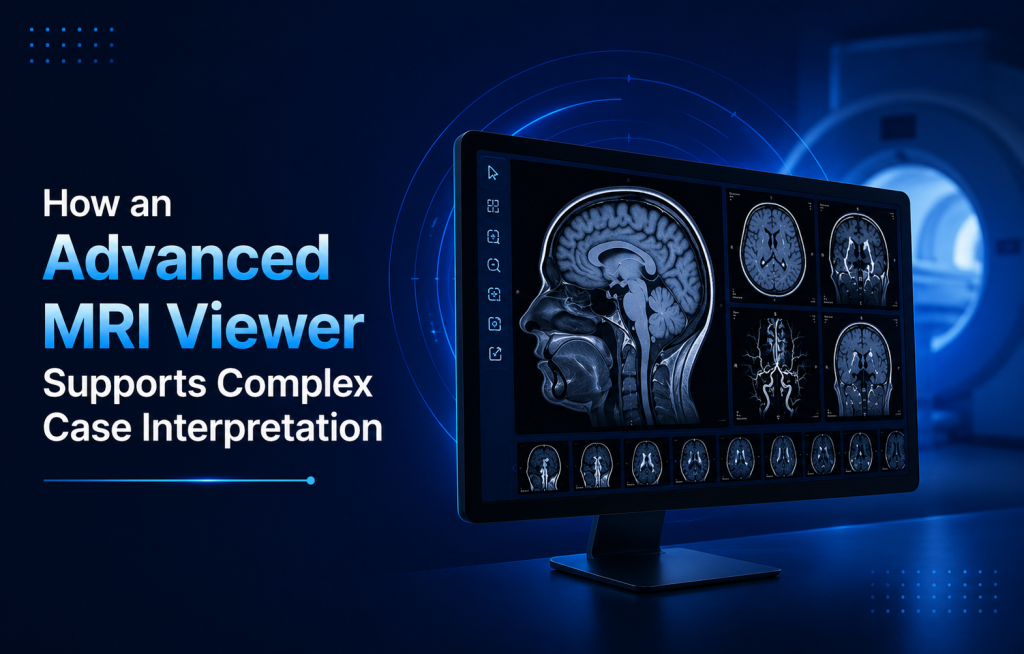
Magnetic Resonance Imaging (MRI) is one of the most powerful diagnostic tools in modern medicine. It provides detailed images of soft tissues, organs, and the nervous system, enabling physicians to diagnose conditions ranging from tumors to neurological disorders with high precision. However, interpreting complex MRI studies requires more than just technical skill—it requires access to advanced visualization tools that allow radiologists to analyze images efficiently and accurately.
An advanced MRI viewer is designed to meet this need. By offering high-resolution display, multi-planar reconstruction, and integration with other imaging modalities, it helps radiologists interpret complex cases with confidence.
High-Resolution Imaging for Critical Detail
MRI studies produce highly detailed images with multiple slices and sequences. Detecting subtle abnormalities, such as small lesions in the brain or early cartilage degeneration in joints, depends on image clarity and precision.
Advanced MRI viewers provide:
- High-resolution display: Ensures no detail is lost even in large datasets.
- Zoom and pan capabilities: Allows radiologists to examine areas of interest closely.
- Windowing and leveling: Adjusts contrast and brightness for optimal tissue differentiation.
These tools are crucial for accurate interpretation, especially in complex cases where small variations can change a diagnosis or treatment plan.
Multi-Planar Reconstruction (MPR)
Complex MRI cases often require viewing anatomy in different planes—axial, sagittal, and coronal. Multi-planar reconstruction enables radiologists to generate these views from a single dataset, enhancing spatial understanding of anatomy and pathology.
Benefits of MPR in an advanced MRI viewer include:
- Comprehensive assessment: View structures from multiple angles without rescanning.
- Improved accuracy: Detect lesions or abnormalities that might be missed in a single plane.
- Faster analysis: Reduces the need for multiple sequences and saves reporting time.
By providing flexible visualization, MPR supports precise diagnosis in challenging cases such as spinal cord injuries, brain tumors, and joint disorders.
Integration with Other Modalities
Complex cases often require correlating MRI findings with other imaging studies like CT scans, PET scans, or X-rays. Advanced MRI viewers support multi-modality comparison by:
- Allowing side-by-side viewing of MRI and other imaging studies
- Enabling image fusion for detailed anatomical correlation
- Synchronizing measurements and annotations across studies
This integration helps radiologists develop a holistic understanding of a patient’s condition, leading to more informed clinical decisions.
Annotation and Measurement Tools
Precise measurement is critical in complex MRI interpretation, particularly for surgical planning, tumor tracking, or monitoring disease progression. Advanced MRI viewers offer:
- Distance and area measurements for accurate lesion sizing
- Volume calculations for tumors or organs
- Annotations and notes directly linked to specific images
These tools streamline reporting and provide clear, actionable information to referring physicians and surgeons.
Workflow Optimization
Radiologists often manage high volumes of studies under tight deadlines. An advanced MRI viewer improves workflow efficiency by:
- Providing fast loading of large MRI datasets
- Integrating with PACS and RIS systems for automatic study retrieval and reporting
- Supporting customizable worklists to prioritize urgent or complex cases
By reducing time spent navigating images and managing files, radiologists can focus on interpretation and clinical decision-making, ultimately improving patient care.
Collaboration and Remote Reporting
Modern healthcare relies on teamwork and multi-center collaboration. Advanced MRI viewers support collaboration by allowing:
- Secure sharing of studies with colleagues or referring physicians
- Simultaneous access for multiple radiologists reviewing the same case
- Remote reporting capabilities for teleradiology and expert consultations
This collaborative functionality ensures that complex cases receive comprehensive review, even if specialists are located at different facilities or countries.
Supporting AI and Advanced Analytics
Some advanced MRI viewers integrate with AI-powered tools that assist in detecting abnormalities, prioritizing urgent cases, and quantifying findings. Features may include:
- Automated detection of brain lesions, tumors, or vascular anomalies
- Pre-populated measurements and segmentation for faster reporting
- Alerts for critical findings that require immediate attention
By combining human expertise with AI assistance, radiologists can improve accuracy, reduce fatigue, and deliver faster diagnoses in high-volume environments.
Enhancing Training and Education
Advanced MRI viewers are also valuable educational tools. Trainees and junior radiologists can learn from:
- Annotated cases with expert interpretations
- Multi-planar and multi-modality visualization
- Interactive tools for hands-on experience
This capability helps build expertise in handling complex cases and prepares the next generation of radiologists for real-world challenges.
Conclusion
Complex MRI cases demand precision, speed, and collaboration. An advanced MRI viewer empowers radiologists to meet these demands by providing high-resolution imaging, multi-planar reconstruction, annotation tools, and integration with other imaging modalities.
By improving accuracy, streamlining workflow, enabling collaboration, and supporting AI-assisted analysis, advanced MRI viewers not only enhance diagnostic quality but also improve patient outcomes. In today’s fast-paced healthcare environment, every radiologist benefits from a reliable, feature-rich MRI viewer that supports complex case interpretation and ensures timely, confident diagnoses.
FAQs
An advanced MRI viewer is software that provides high-resolution imaging, multi-planar reconstruction, and integration with other modalities to help radiologists interpret complex MRI cases accurately
It allows radiologists to view anatomy in axial, sagittal, and coronal planes from a single dataset, improving lesion detection and spatial understanding without additional scans.
Yes, they enable secure sharing of studies, simultaneous review by multiple radiologists, and teleradiology reporting, facilitating expert consultations across locations.
These tools allow precise lesion sizing, volume calculations, and linked annotations, streamlining reporting, surgical planning, and clinical decision-making.
Many viewers integrate AI for automated detection, segmentation, and prioritization of critical findings, enhancing diagnostic accuracy and reducing reporting time.