
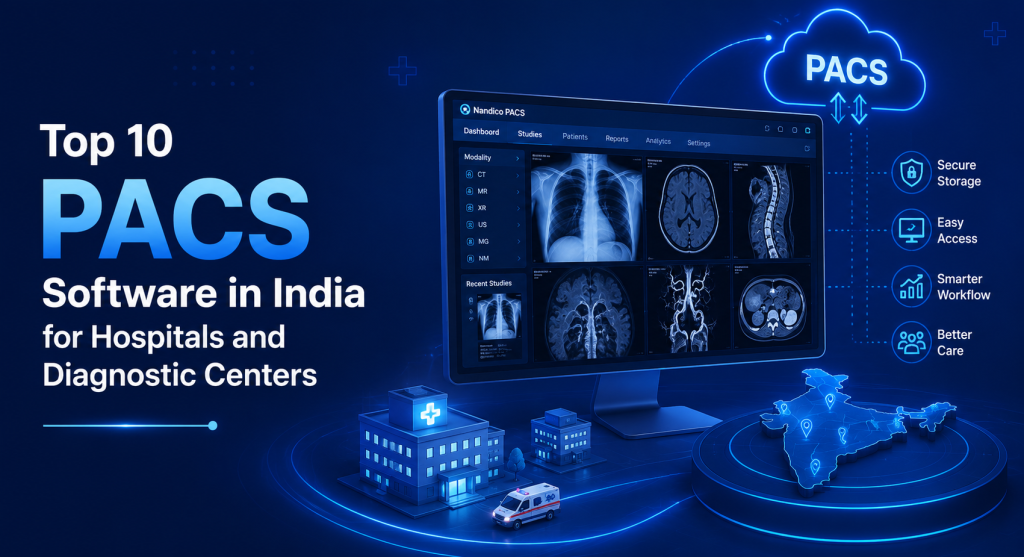
Medical imaging has become an essential part of modern healthcare. Hospitals and diagnostic centers handle thousands of imaging studies every day, including CT scans, MRI scans, X-rays, and ultrasound images. Managing these large volumes of medical data efficiently requires a reliable PACS (Picture Archiving and Communication System).
A good PACS software helps healthcare providers store, view, share, and manage medical images while improving reporting speed and collaboration between doctors and radiologists. With the increasing demand for faster diagnosis and remote reporting, hospitals are now looking for advanced, secure, and scalable PACS solutions.
Here are the top 10 PACS software solutions in India that help hospitals and diagnostic centers improve their radiology workflows.
1. Nandico – Advanced Cloud PACS Solution for Modern Healthcare
Nandico is a next-generation cloud-based PACS platform designed to simplify medical imaging workflows for hospitals, diagnostic centers, and teleradiology providers. It helps radiologists access, analyze, and share medical images securely from anywhere while improving reporting efficiency.
Unlike traditional PACS systems that depend heavily on local servers and hardware maintenance, Nandico provides a flexible cloud-based environment that supports faster image access, remote reporting, and seamless collaboration.
Features of Nandico
- Cloud-Based PACS Platform
Nandico allows hospitals to store and manage medical images securely on cloud infrastructure without depending on expensive local servers. - Advanced DICOM Viewer
Radiologists can view different imaging modalities, including CT, MRI, and X-ray studies, with advanced visualization tools for accurate diagnosis. - RIS/HIS Integration Support
Nandico connects smoothly with hospital systems to improve workflow automation and reduce manual data entry. - Remote Reporting Capability
Radiologists can securely access cases from different locations, making it suitable for teleradiology services. - Secure Medical Data Management
The platform focuses on protecting sensitive patient information through secure access controls and reliable storage.
Benefits of Nandico
Nandico helps healthcare organizations improve their radiology operations by providing:
- Faster image loading and reporting workflows
- Easy collaboration between doctors and radiologists
- Reduced dependency on physical infrastructure
- Better management of increasing imaging volumes
- Support for multi-location healthcare networks
By simplifying complex imaging workflows, Nandico enables hospitals to focus more on patient care rather than managing technical challenges.
Why Choose Nandico?
Modern healthcare requires a PACS solution that is flexible, scalable, and ready for future technologies. Nandico combines cloud accessibility, advanced imaging tools, and workflow efficiency to support the changing needs of hospitals and diagnostic centers.
Its ability to support remote reporting, integration, and secure image management makes it a suitable choice for organizations looking to upgrade from traditional PACS systems.
Best For
Nandico is ideal for:
- Hospitals
- Diagnostic imaging centers
- Radiology departments
- Teleradiology providers
- Multi-location healthcare networks
2. Fujifilm Synapse PACS
Fujifilm Synapse PACS is a widely used medical imaging platform designed for hospitals and healthcare organizations. It provides advanced image management, visualization tools, and workflow solutions for radiology departments. The platform supports multiple imaging modalities and helps radiologists improve diagnostic efficiency through organized workflows.
3. Agfa HealthCare Enterprise Imaging
Agfa HealthCare Enterprise Imaging provides healthcare organizations with a centralized imaging management solution. It focuses on improving collaboration between departments by connecting different imaging workflows into one platform. The solution supports hospitals looking for enterprise-level imaging management and workflow optimization.
4. Philips IntelliSpace PACS
Philips IntelliSpace PACS is a healthcare imaging solution designed to help radiologists review and manage medical images efficiently. It provides advanced visualization capabilities and supports different imaging modalities. Hospitals use this platform to improve workflow consistency and enhance diagnostic processes.
5. GE Healthcare Centricity PACS
GE Healthcare Centricity PACS is an established imaging solution used by healthcare providers worldwide. It helps manage medical images, reports, and radiology workflows. The platform supports efficient image access and collaboration between radiologists and clinicians.
6. Siemens Healthineers Syngo Carbon
Siemens Healthineers Syngo Carbon is an enterprise imaging solution that helps healthcare organizations manage diagnostic data across different departments. It focuses on improving workflow efficiency, image access, and collaboration between healthcare professionals.
7. Carestream PACS
Carestream PACS is a medical imaging management solution designed to support hospitals and diagnostic centers with efficient image storage, viewing, and workflow management. It provides tools for managing different imaging modalities and helps radiologists access studies quickly for reporting.
The platform focuses on improving productivity by organizing imaging workflows and simplifying communication between radiologists and healthcare teams. It is suitable for organizations looking for a reliable PACS solution to manage increasing volumes of medical images.
8. INFINITT PACS
INFINITT PACS is a healthcare imaging platform that provides advanced image viewing and management capabilities for hospitals and diagnostic centers. It supports multiple imaging specialties and helps radiologists analyze studies efficiently.
The solution offers features such as image distribution, workflow management, and integration capabilities with healthcare systems. It is designed to support organizations that require efficient imaging operations and improved collaboration between medical professionals.
9. RamSoft PowerServer PACS
RamSoft PowerServer PACS is a web-based imaging solution designed for radiology practices, hospitals, and diagnostic centers. It focuses on simplifying image management while providing secure access to medical studies.
The platform supports DICOM imaging, remote access, and workflow automation features. It helps radiologists manage cases efficiently and supports modern healthcare environments where flexibility and remote reporting are becoming increasingly important.
10. Sectra PACS
Sectra PACS is an enterprise imaging solution used by healthcare organizations for managing medical images and radiology workflows. It provides advanced visualization tools, secure image access, and collaboration features for healthcare professionals.
The platform is designed to support large healthcare networks that need reliable imaging infrastructure and efficient diagnostic workflows.
Factors to Consider Before Choosing PACS Software
Selecting the right PACS software is an important decision for hospitals and diagnostic centers. Before choosing a solution, healthcare providers should consider the following factors:
1. Cloud or On-Premises Infrastructure
Hospitals should evaluate whether they need a cloud-based PACS or traditional server-based solution. Cloud PACS generally offers easier scalability, remote access, and lower infrastructure requirements.
2. DICOM Compatibility
A reliable PACS should support DICOM standards to ensure smooth handling of medical images from different imaging devices.
3. RIS and HIS Integration
Integration with existing hospital systems improves workflow efficiency by reducing manual data entry and improving information sharing.
4. Security and Data Protection
Medical images contain sensitive patient information. The chosen PACS should provide secure access control, data protection, and reliable backup options.
5. Scalability
As imaging volumes increase, hospitals need a PACS solution that can handle growing data requirements without affecting performance.
6. Remote Access and Teleradiology Support
Modern healthcare requires flexibility. PACS should allow authorized radiologists to securely access and report cases from different locations.
Conclusion
Choosing the right PACS software is essential for hospitals and diagnostic centers that want to improve imaging workflows, reduce reporting delays, and provide better patient care. With increasing imaging volumes and growing demand for remote healthcare services, modern PACS solutions need to offer speed, security, integration, and flexibility.
While several PACS platforms are available in India, cloud-based solutions like Nandico are helping healthcare providers move toward smarter and more efficient radiology workflows. With features such as advanced DICOM viewing, remote reporting support, secure cloud storage, and workflow optimization, Nandico provides a future-ready solution for hospitals, diagnostic centers, and teleradiology networks.
As healthcare continues becoming more digital, investing in the right PACS platform can help organizations deliver faster diagnoses, improve collaboration, and create a more efficient radiology ecosystem.
FAQs
PACS software is used to store, manage, view, and share medical images such as CT scans, MRI scans, X-rays, and ultrasound studies. It helps radiologists access images digitally and improves reporting workflows.
The best PACS software depends on hospital requirements, workflow needs, and scalability. Modern cloud-based solutions like Nandico are becoming popular because they provide secure image access, remote reporting support, and flexible healthcare workflows.
Cloud PACS offers several advantages compared to traditional systems, including easier scalability, remote accessibility, reduced hardware dependency, and simplified maintenance. It is especially useful for growing hospitals and multi-location healthcare networks.
Yes, modern PACS solutions support teleradiology by allowing radiologists to securely access and review medical images from remote locations. This helps hospitals provide faster reporting services.
PACS improves radiology workflow efficiency by organizing medical images, reducing manual processes, and allowing radiologists to access studies quickly. With features like DICOM viewing, remote access, and integration with RIS and HIS systems, PACS helps reduce reporting delays and improves collaboration between healthcare teams.