
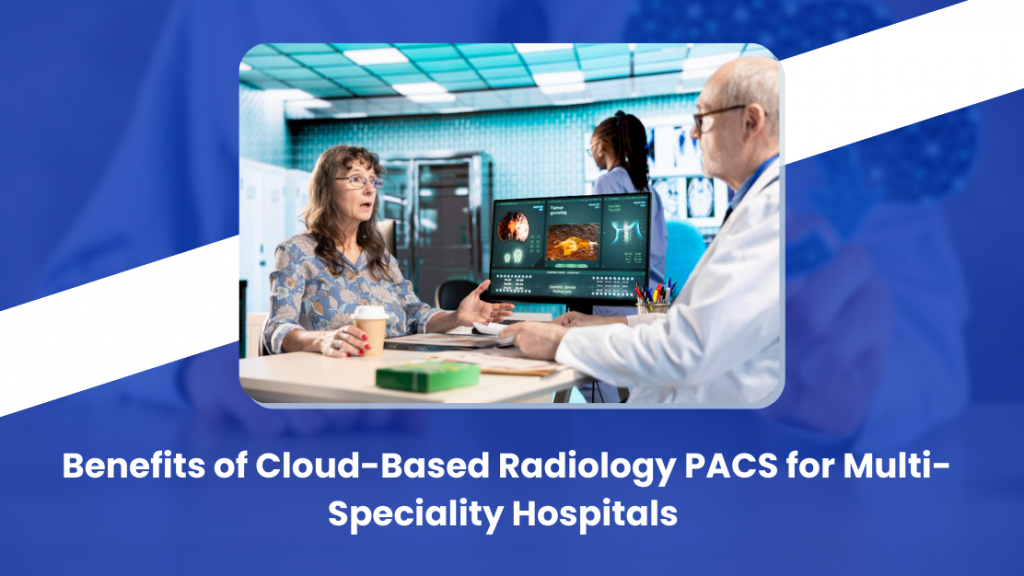
Multi-specialty hospitals handle a wide range of medical cases every day. From emergency trauma care and cardiac procedures to oncology and orthopedics, these hospitals rely heavily on medical imaging to support accurate diagnosis and treatment planning.
As patient numbers increase and imaging technologies become more advanced, managing large volumes of diagnostic data becomes more challenging. Traditional systems that store images on local servers often struggle to provide the flexibility and performance needed in a fast-moving, multi-department environment.
This is why many healthcare institutions are adopting cloud based radiology PACS to streamline operations, improve collaboration, and support long-term growth. Let’s explore the key benefits this modern technology offers to multi-specialty hospitals.
Centralized Access Across Departments
In a multi-specialty hospital, different departments frequently need access to imaging studies. For example:
- Cardiologists review CT angiography scans
- Orthopedic surgeons analyze MRI results
- Oncologists monitor tumor progression through serial imaging
A cloud-based system allows authorized doctors across departments to access the same images instantly from a secure platform. There is no need to transfer files manually or rely on physical media like CDs.
This centralized access improves coordination between specialists and ensures faster treatment decisions.
Faster Image Loading and Reporting
Speed is essential in healthcare. Emergency cases require immediate diagnosis, and even routine imaging must be reported quickly to avoid treatment delays.
Cloud based radiology PACS platforms are designed to handle large imaging datasets efficiently. High-resolution CT and MRI scans load quickly, and radiologists can scroll smoothly through hundreds of images without lag.
Faster image access leads to quicker report turnaround times, helping hospitals improve patient flow and reduce waiting periods.
Seamless Multi-Location Integration
Many multi-specialty hospitals operate across multiple branches or satellite centers. Managing imaging data across locations can be difficult with traditional systems that rely on local servers.
Cloud technology connects all facilities under one unified platform. Images captured at one branch can be accessed instantly at another location. This is especially useful when specialists are not physically present at every site.
Such integration supports centralized reporting and balanced workload distribution among radiologists.
Improved Collaboration Among Specialists
Modern healthcare depends on teamwork. Complex cases often require discussion between radiologists, surgeons, physicians, and other specialists.
With cloud-based imaging platforms, multiple users can view the same study securely. Doctors can compare prior scans, review reports, and coordinate treatment plans without delay.
This real-time collaboration reduces miscommunication and improves overall care quality.
Scalable Storage for Growing Data
Imaging equipment continues to evolve, producing higher-resolution and larger files. Multi-specialty hospitals generate thousands of imaging studies each month.
Traditional systems require frequent hardware upgrades to handle growing storage needs. This can be costly and disruptive.
Cloud based radiology PACS provides scalable storage that expands as needed. Hospitals can increase capacity without purchasing additional servers or scheduling downtime for installation.
This flexibility supports long-term growth without technical limitations.
Reduced IT Infrastructure Burden
Maintaining on-site servers requires dedicated IT staff for hardware management, software updates, and data backups. For large hospitals, this becomes a continuous operational responsibility.
Cloud systems reduce this burden. Maintenance, updates, and security enhancements are managed through secure cloud infrastructure. Hospitals can focus more on patient care rather than technical maintenance.
This not only saves time but also reduces operational costs.
Enhanced Data Security and Backup
Patient data protection is critical. Multi-specialty hospitals handle sensitive information that must remain secure at all times.
Cloud platforms use encrypted data transmission, secure storage environments, and controlled user access. In addition, automatic backups and disaster recovery options protect against unexpected events such as hardware failures or natural disasters.
In many cases, cloud security standards exceed those of older local systems.
Support for Remote Reporting and Teleradiology
Radiologists may not always be present on-site, especially in hospitals with multiple branches. Cloud access allows authorized professionals to review and report imaging studies from remote locations.
This ensures continuous service during night shifts, emergencies, or staff shortages. It also allows hospitals to consult external specialists when needed.
Remote accessibility increases flexibility and helps maintain consistent diagnostic services.
Better Workflow Efficiency
Cloud based radiology PACS systems are designed to improve workflow. Features such as organized worklists, easy comparison with previous studies, and integrated reporting tools reduce manual tasks.
Radiologists can focus more on interpretation rather than navigating complex systems. Efficient workflows improve productivity and reduce stress for medical staff.
Cost-Effective Long-Term Investment
While traditional systems require significant upfront investment in servers and infrastructure, cloud-based platforms often operate on predictable subscription models.
This allows hospitals to manage budgets more effectively and avoid sudden hardware replacement costs. As the hospital grows, the system adapts without major financial disruption.
Over time, this approach proves more cost-efficient and sustainable.
Conclusion
Multi-specialty hospitals face complex challenges when managing large volumes of medical imaging data. They require systems that provide speed, scalability, security, and seamless collaboration across departments and locations.
Cloud based radiology PACS offers a modern solution that meets these demands. By enabling centralized access, faster reporting, remote flexibility, scalable storage, and strong data protection, cloud platforms support efficient and coordinated healthcare delivery.
As hospitals continue to expand and imaging technology advances, adopting cloud-based imaging infrastructure is no longer just an upgrade—it is a strategic decision for long-term success and improved patient care.
FAQs:
Multi-specialty hospitals handle diverse imaging needs across departments. Cloud PACS centralizes data access, allowing different specialists to view studies instantly, improving coordination and speeding up clinical decisions.
Cloud PACS allows multiple doctors to securely access the same imaging studies in real time. This enables better communication between radiologists, surgeons, and physicians, reducing delays and improving treatment accuracy.
Yes, cloud PACS connects all hospital locations through a single platform. Imaging data can be accessed from any branch, enabling centralized reporting and efficient workload distribution across radiology teams.
Modern cloud PACS systems use encryption, role-based access control, and automated backups. These features ensure that patient data remains protected while meeting healthcare compliance requirements.
Cloud PACS eliminates the need for expensive on-site servers and reduces IT maintenance costs. Its subscription-based model allows hospitals to scale usage efficiently without large upfront investments.