
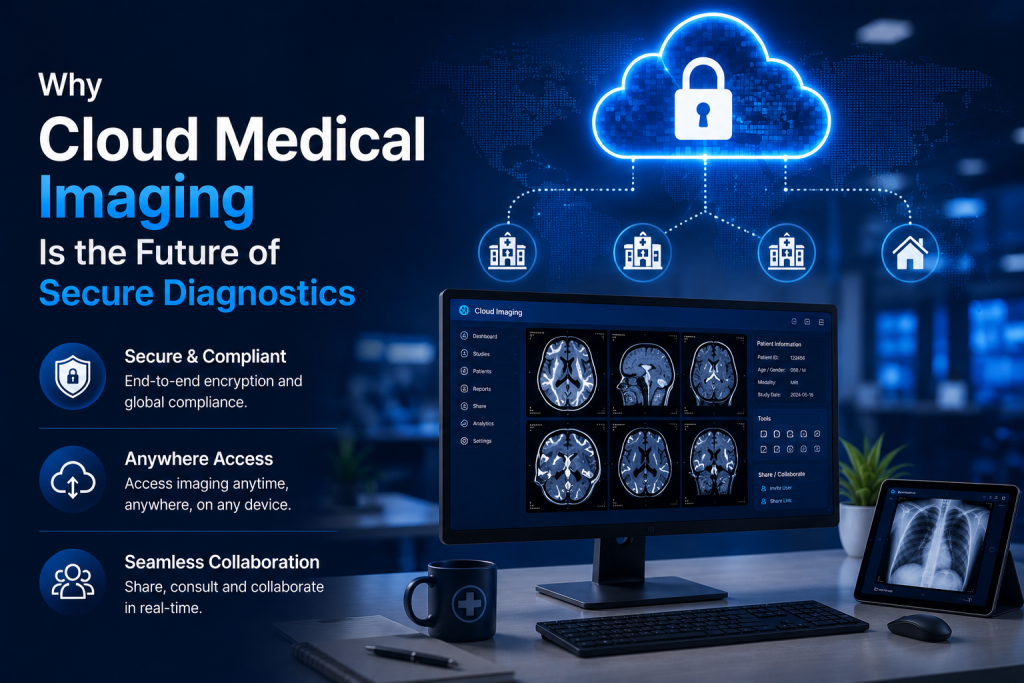
Medical imaging is at the heart of modern healthcare. From detecting early-stage diseases to guiding complex surgeries, imaging technologies like X-rays, CT scans, MRIs, and ultrasounds provide critical insights for physicians. As hospitals and diagnostic centers handle increasing volumes of imaging studies, the need for secure, fast, and reliable image management has never been higher.
Traditional on-premises systems for storing and sharing medical images often come with limitations such as high costs, maintenance challenges, and restricted accessibility. Cloud medical imaging has emerged as a transformative solution, offering secure, scalable, and efficient management of imaging data.
Centralized and Secure Image Storage
One of the most significant advantages of cloud medical imaging is centralized storage. Instead of storing images on local servers or physical media, studies are securely stored in the cloud. This centralization ensures:
- Enhanced security: Data is encrypted during transfer and storage, preventing unauthorized access.
- Reduced risk of data loss: Automatic backups and disaster recovery plans protect against hardware failures or accidental deletion.
- Compliance with healthcare regulations: Cloud solutions can maintain HIPAA and other international standards for patient privacy and data security.
Centralized, secure storage gives healthcare providers confidence that patient imaging data is safe, accessible, and compliant with global standards.
Easy Access and Remote Diagnostics
Cloud medical imaging allows authorized users to access studies anytime, anywhere, using secure web-based platforms. This capability supports:
- Teleradiology and remote reporting: Radiologists can review scans from home or satellite clinics.
- Multi-center collaboration: Specialists across hospitals can view and discuss studies simultaneously.
- Faster emergency response: Critical cases can be accessed immediately, regardless of location.
Remote access ensures that urgent diagnoses are not delayed, which is crucial for patient care in emergencies and multi-location healthcare networks.
Scalability for Growing Imaging Volumes
Healthcare facilities often face increasing imaging volumes due to rising patient demand and expanding diagnostic services. On-premises systems require additional hardware, storage, and IT maintenance to accommodate growth, which can be expensive and time-consuming.
Cloud medical imaging solves this problem by offering scalable storage and processing capacity. Hospitals can easily add storage, support more imaging modalities, and expand operations without significant infrastructure investment. This flexibility allows facilities to adapt to growth efficiently and cost-effectively.
Seamless Integration with PACS and RIS
Cloud-based solutions integrate smoothly with PACS (Picture Archiving and Communication System) and RIS (Radiology Information System). Integration ensures:
- Automatic synchronization of patient data and imaging studies
- Streamlined workflow from image acquisition to reporting
- Reduced administrative errors from manual data entry
By creating a unified imaging ecosystem, cloud medical imaging enables radiologists to focus on interpretation and diagnosis rather than managing technical and administrative tasks.
Improved Workflow Efficiency
Cloud platforms optimize radiology workflows in several ways:
- Fast image loading: High-resolution CT and MRI scans load quickly, even over standard internet connections.
- Remote collaboration: Multiple radiologists can access the same study simultaneously.
- AI integration: Cloud-based systems can support AI-assisted analysis, helping radiologists identify critical findings faster.
These features reduce reporting time, improve productivity, and enhance diagnostic accuracy, directly benefiting patient care.
Cost-Effective and Low Maintenance
Traditional on-premises storage systems require significant upfront investment in servers, networking hardware, and IT personnel. Cloud medical imaging offers a subscription-based model, which includes maintenance, upgrades, and support.
Benefits include:
- Predictable operational costs
- Reduced IT burden for hospitals
- Automatic updates and security patches
By minimizing hardware dependence and administrative overhead, cloud imaging solutions allow healthcare facilities to allocate resources more efficiently.
Enhanced Collaboration Across Teams
Healthcare increasingly relies on teamwork. Cloud medical imaging enables real-time collaboration between radiologists, clinicians, surgeons, and referring physicians. Features such as annotation sharing, side-by-side comparison, and multi-user access enhance decision-making and reduce delays.
Whether it is a rural clinic consulting an urban specialist or a multi-hospital network managing complex cases, cloud-based imaging ensures seamless collaboration for better patient outcomes.
Future-Ready Technology
The healthcare landscape is rapidly evolving with AI, big data analytics, and predictive diagnostics. Cloud-based imaging platforms are well-positioned to support these innovations by:
- Hosting AI algorithms for automated detection and triage
- Analyzing large datasets for population health insights
- Enabling remote monitoring and telemedicine initiatives
By adopting cloud medical imaging, hospitals prepare their radiology departments for the next generation of diagnostic technology.
Conclusion
Cloud medical imaging is revolutionizing diagnostics by offering secure, scalable, and accessible solutions for managing medical images. With centralized storage, remote access, workflow optimization, and integration with PACS and RIS, cloud solutions address the limitations of traditional on-premises systems.
Hospitals and diagnostic centers benefit from faster reporting, enhanced collaboration, cost savings, and future-ready technology. In an era where timely, accurate, and secure diagnostic services are essential, cloud medical imaging is no longer just an option—it is the future of healthcare.
By embracing cloud-based solutions, healthcare providers can improve operational efficiency, enhance patient care, and stay ahead in the rapidly evolving world of medical diagnostics.
FAQs
Cloud medical imaging stores and manages medical images like CTs, MRIs, and X-rays on secure cloud servers, enabling remote access, collaboration, and AI integration.
It enables fast image loading, real-time multi-user access, and seamless integration with PACS/RIS, reducing reporting time and enhancing diagnostic accuracy.
Yes, images are encrypted during storage and transfer, with automatic backups and compliance with HIPAA and international patient data regulations.
Absolutely. Cloud platforms offer scalable storage and processing capacity, allowing facilities to manage growing imaging volumes without costly hardware upgrades.
Multiple radiologists and clinicians can simultaneously access, annotate, and review studies, improving decision-making and accelerating patient care across locations.